
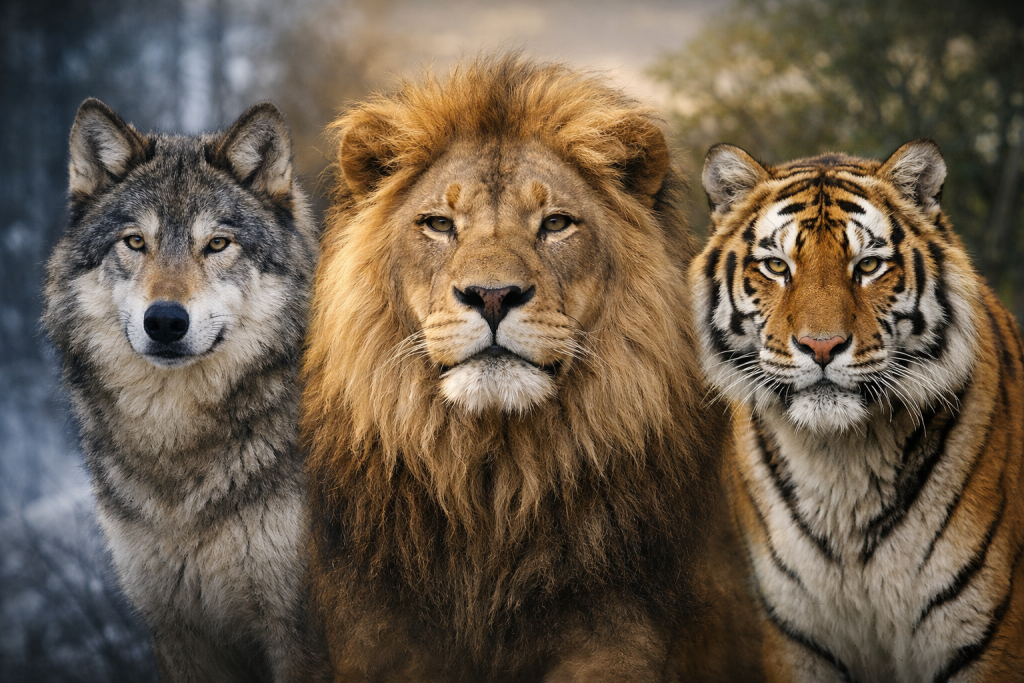
In the Wild was a television series built around a simple but compelling idea: a well‑known Hollywood actor travels into the field to encounter an animal that has shaped their imagination. I grew up with the series, and two episodes in particular stayed with me.
One followed (Sir) Anthony Hopkins to Tanzania in East Africa, where he travelled across open savannahs and among established prides to observe lions in the landscapes that shaped their behaviour, their hunting strategies, and their place in both local culture and global mythology. Another took Bob Hoskins to Sumatra and to Nepal and India, where he moved through dense forests, seeking out the last strongholds of wild tigers and highlighting the uneasy balance between their iconic status and the shrinking habitats that still support them. Each episode paired the actor’s personal fascination with the unfiltered reality of encountering these big cats in the wild.
Recently, I discovered an episode I had never seen before—in which Timothy Dalton travels through Alaska and Minnesota to observe wolves in the wild. What struck me immediately was how naturally this episode sits beside the lion and tiger stories. Wolves, like the great cats, have long been feared as killers of man, yet they are often burdened with an even harsher reputation. Dalton’s journey is shaped by a desire to dismantle that old caricature of the wolf as a savage menace and instead reveal the animals as they truly is: intelligent, social, and fully entitled to their place in the landscape.
I have always had five favourite animals—lions, tigers, wolves, apes, and eagles. The series never produced an ape episode that resonated with me, and it never touched eagles at all. But the three episodes that did align with my interests—Hopkins with lions in Tanzania, Hoskins with tigers in Nepal, and now Dalton with wolves in Alaska and Minnesota—share a surprising thematic unity. For years I assumed the lion and tiger episodes were uniquely parallel because they both dealt with big cats and actors travelling to meet them in their native habitats. Yet discovering Dalton’s wolf episode made me realise that the similarities run deeper than species. Even though wolves are the ancestors of domestic dogs—a distinction that sets them apart from the big cats—the emotional and narrative structure of Dalton’s journey mirrors the earlier two in compelling ways.
Early Fascination
A striking coincidence links these three journeys: all the actors are English, yet each one formed a lifelong connection with a different apex predator long before travelling into the wild to see that animal in the wild.
(Sir) Hopkins first felt drawn to lions at the age of six, after seeing a lion behind the bars of a zoo. That early encounter stayed with him, and as he grew older, he became increasingly aware of how deeply the lion is woven into global symbolism. Lions stand guard in Trafalgar Square, appear above the doorway of the Cock and Lion in London, and roar across cinema screens in the MGM emblem. (Sir) Hopkins admired the lion’s long‑standing title as the “King of Animals”, and even kept a domestic cat of his own, a small reminder of the larger feline presence that had fascinated him since childhood. That lifelong admiration eventually inspired him to travel into the wild and see lions living freely on the landscape that shaped their behaviour.
Bob Hoskins developed his fascination in a very different setting. Before becoming a celebrated actor, he worked as a fire‑eater in a circus, and during those years he often stood close to performing tigers. To Hoskins, watching a tiger move under the circus lights felt like witnessing “fire on four legs.” The experience stayed with him, and later he maintained a small wildlife preserve in England. Hoskins once said that when he thought of lions, he thought of strength and courage, but when he thought of tigers, words failed him — only feelings remained. As he learned more about the tiger’s precarious status in the modern world, he became determined to support conservation efforts and to travel into the wild in search of a tiger living freely in forest country.
Timothy Dalton’s early connection to wolves is less clearly documented, yet he understood that wolves evoke fear in many people, even though very few have ever seen a wolf in the wild. That contradiction fascinated him. Dalton wanted to understand the wolf’s true nature — the social relationships, the intelligence, the endurance — and he felt compelled to travel into wolf country to witness those qualities firsthand.
Early Fascination
One of the most striking contrasts across the three journeys lies in how each episode stages the movement into the field—the “in-between” space where ordinary life begins to give way to wilderness. Rather than presenting travel as a single, uniform transition, each story isolates a different fragment of departure, and those choices subtly reshape how the viewer experiences what follows.
With (Sir) Hopkins’ episode, the journey is shown in its earliest, most grounded form. We only see him in a cab heading toward the airport, moving through a familiar city scene that feels almost incidental. There is no departure montage or extended travel sequence—just that quiet moment of leaving urban space behind. That simplicity is important. It frames Tanzania as something entirely beyond the everyday world he has just stepped out of, making the eventual arrival in Tanzania feel like a clear and decisive rupture.
Hoskins’ episode extends the idea of travel further, but still keeps it tightly framed. Rather than stopping at the airport threshold, he is shown on the aircraft itself, already in transit toward Indonesia. The journey is no longer implied or truncated—it is physically underway. This mid-air perspective gives his story a sense of momentum, as though the act of crossing distance is already part of the experience of seeking tigers. The viewer is made aware not only of departure, but of sustained movement across space, with all the anticipation that builds inside that suspended in-between state.
Timothy Dalton’s episode, by contrast, shifts the entire structure. Instead of beginning with departure, he is already in California when the story opens. The travel phase has effectively happened off-screen, folded into the narrative before the wildlife journey properly begins. What we see first is not movement toward the wild, but a man situated within a modern, human environment. Only after this grounding does the episode begin to orient itself toward wolf country.
This ordering creates an unusual inversion. Hopkins begins with departure at street level, Hoskins continues the journey in mid-air, while Dalton begins after arrival in a place that is still part of the human world. As a result, his urban scenes feel less like prelude and more like framing—an intentional pause before the outward shift into wilderness. In Hopkins and Hoskins’ episodes, their hometown is something to leave behind to head off for the trip; in Dalton’s, it is something to observe first.
Taken together, these different entry points show how each episode treats arrival not as a single moment, but as a sequence that can be stretched, compressed, or even displaced. The result is that the journey into the wild begins long before the animals appear—it begins in how each story chooses to show the act of getting there at all.
Hunters, Respect, and Shared Worlds
Across all three episodes, the actors come to understand not only the extent to which their chosen animals—the Lion, the Tiger, and the Wolf—have been hunted by humans, but also the complex mix of fear, necessity, and respect that shapes those interactions. Each journey reveals that human attitudes are rarely one-dimensional. Alongside accounts of hunting, there is often a deep acknowledgement of the animal’s strength, intelligence, and rightful place in the landscape.
The presentation of this idea varies across the episodes. During (Sir) Anthony Hopkins’ journey in Tanzania, the history of Lion hunting is conveyed through archival photographs from the era of German East Africa, showing Lion trophies and hinting at a past where dominance over the animal was openly displayed. Bob Hoskins’ experience is more immediate and personal, as he speaks directly with a former Tiger hunter, accompanied by footage of a Tiger hunt from the 1980s. In Timothy Dalton’s case, the perspective shifts again. Upon arriving in Alaska, he meets an Inuit member of the Iñupiat community who has collected Wolf pelts, yet whose cultural understanding of the Wolf differs profoundly from conventional ideas of hunting.
For the Iñupiat and other Inuit groups, hunting and deep respect are not contradictory. Instead, they form part of a reciprocal spiritual relationship between humans and animals. Within this worldview, animals are regarded as sentient beings that may willingly give themselves to hunters who show proper honour and respect. The Wolf, in particular, is seen as an important cultural and spiritual guide—a “great teacher” admired for mastery of survival in some of the harshest environments on Earth. By observing the Wolf, hunters have traditionally learned how to track prey and cooperate effectively, especially when hunting caribou. The Wolf’s strong social structure and cooperative care for young also reflect the values of close-knit Inuit communities.
This relationship is further shaped by spiritual beliefs rooted in animism. In Inuit tradition, animals possess a tarniq, or immortal soul, and hunting is understood as part of a deeper spiritual exchange. It is believed that an animal will only allow itself to be taken by a hunter who behaves with humility, generosity, and respect. A hunter who acts carelessly risks offending the spirits, which may then withhold game and bring hardship. By treating the animal’s remains with care and sharing the meat within the community, the cycle continues, allowing the soul to return again in another form.
The Wolf is also seen as a partner in maintaining the balance of nature. A well-known idea expresses that the Wolf keeps the caribou strong, as Wolves tend to target the weak or sick members of a herd. In this way, both humans and Wolves are understood as apex hunters sharing the same environment. Rather than rivals, they are seen as participants in a shared system, each playing a role in sustaining the health of the land. The Wolf also carries symbolic meaning, with parts such as skin or teeth traditionally used as amulets believed to hold the animal’s qualities, allowing hunters or shamans to draw upon the Wolf’s endurance, awareness, and resilience. In spiritual life, the Wolf is also connected to the unseen world, with shamans calling upon Wolf spirits for protection and guidance.
A comparable sense of respect exists within Maasai culture, which (Sir) Hopkins encounters shortly after his first Lion sighting. Although the Maasai are known for hunting Lions, this practice has long been guided by cultural meaning and restraint. One of the most important reasons for hunting was the rite of passage known as olamayio, through which a young man proved his courage and became a moran, or warrior, by killing a Lion with a spear. This act brought honour, status, and recognition within the community.
Lion hunting also served the practical purpose of protecting livestock. As pastoralists, the Maasai place great value on their cattle, and when a Lion threatened or killed livestock, retaliatory hunts were carried out to defend the herd. At the same time, Lion hunting was tied to identity and life milestones, sometimes influencing marriage and earning the hunter a lasting “lion name.”
Despite this, Maasai hunting traditions were governed by clear rules. Lions were not hunted indiscriminately. Only male Lions were targeted, while lionesses were protected unless they posed a direct threat, as they were seen as the bearers of life. Hunts were expected to be fair and honourable, and Lions that were weak, sick, or trapped were not to be killed. The encounter was meant to be a true test of bravery—a direct contest between worthy opponents.
Even within this framework of hunting, the Lion is regarded with deep respect, seen not simply as prey but as a powerful adversary whose courage commands admiration. A similar reverence appears in Hoskins’ journey, when he observes a ceremonial dance in which participants enter a trance to invoke the spirit of the Tiger. Through the guidance of a Tiger shaman, the dancers seek protection, the driving away of evil, and spiritual strength, reflecting a belief that the Tiger’s power can be shared rather than conquered.
Taken together, these perspectives reveal a unifying theme across the three episodes. Whether through the Lion, the Tiger, or the Wolf, human relationships with these animals are shaped by a balance of survival, reverence, and meaning. Hunting, where it occurs, is rarely just an act of dominance; it is often embedded within systems of belief that recognise the animal as something to be understood, respected, and, in many ways, honoured.
Once the actors leave the city behind and begin the search for their favourite animals, each episode adopts a very different pace, and that difference says much about the nature of the Lion, the Tiger, and the Wolf themselves.
Anthony Hopkins moves into the wild almost immediately. After limited time in the city, he heads directly to Tarangire National Park, where he soon experiences his first Lion encounter—a lioness moving within the open landscape. The moment comes early in the episode and reflects an important reality of Lion country. Despite Hopkins remarking that Lions are difficult to find, they are often far more visible than many other great predators, particularly in open savannah environments where prides live across broad grasslands and spend much of their time above cover.
Bob Hoskins’ journey unfolds much more gradually. Rather than encountering wild Tigers at once, he first sees captive Tigers involved in a breeding programme. His true search for a wild Tiger is delayed until much later, when he eventually takes part in a Tiger safari in Nepal. This slower progression mirrors the Tiger’s elusive nature. Unlike Lions, Tigers are solitary forest dwellers, relying on camouflage, silence, and dense cover. Even in areas where Tigers are present, sightings can never be guaranteed, and the search itself becomes part of the story.
Timothy Dalton’s episode follows yet another path. Before observing Wolves, he is introduced to the broader ecosystem that Wolves inhabit, gaining insight into many of the other animals that share their range. This wider ecological focus is fitting, as Wolves are deeply tied to the landscapes they move through and to the relationships between prey, predators, and human communities. The episode also includes interviews with people who have concerns not only about Wolves, but about other powerful animals such as bears and pumas, whose presence can sometimes create even greater practical difficulties for those living nearby.
This is an especially interesting contrast in tone. The Wolf episode is not limited to defending or romanticising Wolves. Instead, it places them within the broader realities of frontier life, where humans must coexist with multiple large predators, each capable of conflict as well as ecological importance. In doing so, the episode broadens the conversation beyond one species alone.
Taken together, the timing of these first encounters reflects the animals themselves. Lions are comparatively easier to observe in open country, which is why Hopkins sees one early. Tigers, hidden by forests and solitude, reveal themselves much later to Hoskins. Wolves, intelligent and wide-ranging, also come later for Dalton, whose journey first explores the wider world in which they live. The search for each animal therefore becomes a reflection of its character, habitat, and relationship with people.
Man-Eaters, Fear, and the Reality Behind Attacks
Lions, Tigers, and Wolves have all, at different times in history, attacked human beings and earned reputations as man-eaters. Yet while all three predators have inspired fear, the Wolf has often carried the harshest and most enduring image in folklore and popular imagination, frequently portrayed as a relentless threat far beyond what the historical record usually supports.
During (Sir) Hopkins’ journey in Tanzania, this theme surfaces when he boards a train bound for the Tanzanian capital and reflects on the immense hardship faced by the railway workers who once built lines through wild country. He notes that, on one stretch of railway in East Africa, Lions halted construction after devouring more than thirty workers. This is a clear reference to the famous Man-Eaters of Tsavo, two maneless male Lions that terrorised labourers during the building of the Uganda Railway in 1898. Although Hopkins mentions the story in connection with Tanzania, the actual events took place in neighbouring Kenya, in what is now Tsavo National Park near the Tsavo River, although not far from the Tanzanian border.
The Tsavo Lions became one of the most famous cases of predatory attacks on humans, but the episode does not go further into the reasons why some Lions turn to attacking people or how such situations have historically been managed. It also leaves aside the conclusion of the Tsavo case, in which the two Lions were eventually hunted down by Lieutenant Colonel John Henry Patterson after months of fear and disruption. Cases like Tsavo are dramatic, yet they remain exceptional rather than typical Lion behaviour.
Hoskins’ search for Tigers explores the subject more directly and with greater nuance. He explains that Tigers rarely become man-eaters under normal conditions. In many documented cases, a Tiger that turns to hunting humans is old, injured, or otherwise unable to capture natural prey such as deer or wild boar. An injury such as a broken leg can greatly reduce a Tiger’s speed, strength, and ability to stalk effectively. Humans, moving more slowly and often unarmed in forest-edge environments, may then become easier targets.
Hoskins also meets the family of a woman killed by a Tiger, bringing a personal and tragic human dimension to the subject. Later, the Tiger responsible is captured and sent to Kathmandu Zoo, where it is revealed that the animal had a broken leg. This discovery reinforces the long-recognised pattern that many so-called man-eating Tigers are not simply vicious animals, but predators physically compromised and driven toward easier prey through pain and necessity.
Dalton’s quest for Wolves addresses attacks on humans less extensively, yet it suggests an important distinction: many historical Wolf attacks were linked not to healthy predatory Wolves, but to rabies. Rabies is a viral disease that affects the nervous system and can radically alter behaviour, producing aggression, confusion, disorientation, and loss of fear. A rabid Wolf may bite repeatedly and unpredictably, attacking humans or livestock in ways that healthy Wolves almost never would. Before modern vaccination and disease control, outbreaks of rabies in Wolves contributed heavily to the species’ fearful reputation across Europe, Asia, and North America. However it is not true that there has been no record of a Wolf killing a human as Dalton suggests.
This distinction matters greatly. Healthy Wolves are typically wary of people and tend to avoid close contact whenever possible. By contrast, a rabid Wolf behaves abnormally, and such incidents historically shaped many exaggerated tales of savage Wolf attacks. In this sense, disease often played a larger role than natural predatory behaviour in creating the Wolf’s fearsome image.
Taken together, the three episodes hint at a broader truth. The label “man-eater” often hides more than it explains. Sometimes the cause is unusual circumstance, as with the Tsavo Lions; sometimes injury and desperation, as with certain Tigers; and sometimes disease, as in many Wolf attacks. These cases are real and serious, but they are exceptions born of stress, hardship, or abnormal conditions rather than the everyday nature of the animals themselves.
The Rhinoceros Connection
With the exception of Timothy Dalton’s quest to find Wolves, both (Sir) Anthony Hopkins’ journey to find Lions and Bob Hoskins’ journey to find Tigers also draw attention to other threatened wildlife, most notably rhinoceroses. This contrast is understandable, as Wolves do not naturally occur in regions where rhinos survive today, aside from the African Wolf, a species once mistaken for a jackal until DNA studies confirmed a distinct identity. No African Wolves are seen during Hopkins’ Lion journey.
The Ngorongoro Crater, where Hopkins’ search for Lions reaches its conclusion, is famous not only for a strong Lion population but also as one of the finest places in Tanzania to see the endangered Black Rhinoceros. In recent years, the crater has generally supported around 60 to 75 Lions, making the area one of East Africa’s best-known Lion strongholds. At the same time, roughly 20 to 30 Black Rhinoceroses are usually recorded within the wider Ngorongoro Conservation Area crater floor population, one of the most important protected groups of this rare species in Tanzania. During the episode, two Black Rhinoceroses, seemingly a pair, are seen while a lioness introduces her cubs to the pride. The rhinos pay little attention to the nearby cats, illustrating the calm confidence often shown by such heavily built herbivores.
Hoskins’ Tiger journey also brings rhinoceroses into view. When he sets out on elephant-back in search of Tigers, he encounters the Indian Rhinoceros, (first a mother and calf and later a male) another remarkable species whose survival has depended on sustained protection. In places such as Bardia, many visitors are drawn first and foremost by the chance to see rhinos, whose size, visibility, and regular presence make them one of the reserve’s signature attractions. Tigers remain a major ambition for travellers, yet Tiger sightings are naturally less predictable because the great cat moves quietly through cover and often remains unseen. As a result, the Indian Rhinoceros frequently provides the first great wildlife spectacle for many who enter these landscapes, while the Tiger remains the more elusive prize but no less treasured.
The Indian Rhinoceros once faced severe decline, but conservation programmes have helped numbers recover significantly in parts of Nepal and India. Even so, the species still requires constant protection from habitat loss and poaching. The same is true of the Black Rhinoceros, whose numbers were devastated during the twentieth century.
Together, these episodes quietly underline an important truth. While Lions and Tigers command much of the public imagination, the landscapes that sustain those predators also shelter other iconic animals fighting for survival. Rhinoceroses, whether the Black Rhinoceros of Africa or the Indian Rhinoceros of Asia, stand beside Lions and Tigers as living symbols of the need for conservation. Even though Lions are not as globally threatened as Tigers, all three great mammals—and especially the world’s remaining rhino species—depend upon continued protection if future generations are to know them in the wild.
Famous Conservationists and the Fight for the Species
Each episode shows the actors doing more than simply searching for their favourite animal. Along the way, they also engage with the people and organisations working to secure a future for the Lion, the Tiger, and the Wolf. These encounters add an important dimension to the journeys, showing that admiration for such animals often leads naturally into conservation.
During his Tanzanian adventure, (Sir) Hopkins joins members of the Serengeti Lion Project as they dart a lioness in order to fit a tracking collar. The collar allows researchers to follow her movements, understand pride territories, monitor survival, and better study how Lions live across the wider ecosystem. Although Hopkins does not meet Dr. Craig Packer, whose long-running work helped make the Serengeti Lion Project world famous, the sequence still highlights the scientific effort behind modern Lion conservation. Lions are not globally endangered in the same way as Tigers, yet many populations face pressure from habitat loss, conflict with livestock owners, and shrinking prey numbers. Protecting strongholds such as those in Tanzania therefore remains essential.
Bob Hoskins’ Tiger journey places conservation at the very centre of the story. He meets Dr. Ron Tilson, widely regarded as one of the foremost Tiger experts of his era. Their meeting takes place at a breeding centre in Sumatra, where Tilson and other international scientists are working to preserve the future of Tigers through careful management. A major concern is the danger of inbreeding within small, isolated populations, whether captive or wild. By pairing animals from more distant bloodlines and maintaining healthier genetic diversity, conservationists hoped to strengthen future generations and reduce inherited weakness. The long-term aim was not simply to produce cubs, but to safeguard Tigers capable of surviving as robust animals in the future.
Dalton’s Wolf journey is closely tied to field science through his time with David Mech, one of the most respected Wolf researchers in the world, whose studies began in the mid-twentieth century. Much of Dalton’s expedition is spent alongside Mech tracking Wolves by quad bike, locating packs, and helping with the temporary capture of animals for research. Wolves are darted, fitted with radio collars, and then released so their movements and behaviour can be monitored over time. Such work has transformed human understanding of Wolf social life, territorial range, dispersal, and coexistence with people. Dalton also notes a striking detail familiar in wildlife medicine: under tranquiliser drugs, a Wolf may remain with eyes open, much as a darted female Tiger later does during Hoskins’ journey.
These episodes also reveal how each actor interprets the meaning of conservation. Hopkins stresses that Tanzania’s continuing commitment to wildlife has helped keep major Lion populations comparatively secure, even if long-term vigilance is always needed. Hoskins sees the Tiger as a reminder that humanity is not the only force of consequence on Earth; without such predators, the natural world loses one of its great balancing powers. Dalton views the Wolf in simpler and perhaps more misunderstood terms: not as a villain, but as a predator doing what survival demands.
Taken together, the three stories show that conservation is not only about numbers or scientific programmes. It is also about changing attitudes. The Lion, the Tiger, and the Wolf each require habitat, research, and protection, but they also require people willing to understand them beyond myth and fear.