
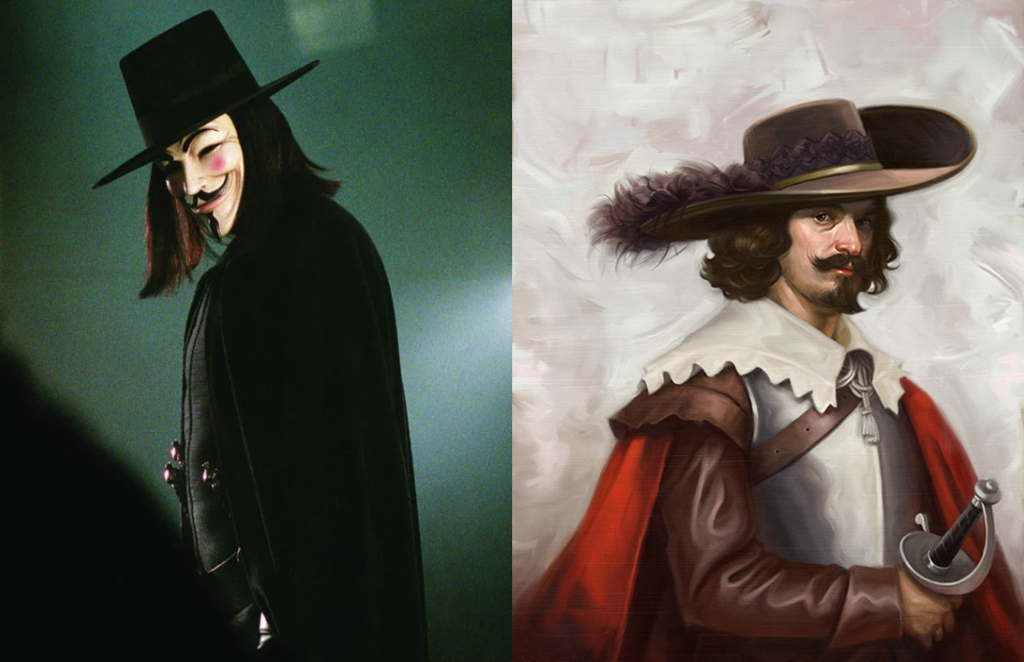
Champlain and V: A Study in Purpose, Strategy, and Connection
Introduction
At first glance, Samuel de Champlain and V for Vendetta have nothing in common. One was a historical French explorer and cartographer whose journeys helped shape what would become parts of Canada and the United States. The other is a fictional masked revolutionary in a repressive Britain, a man of theatre, vengeance, and rebellion. Yet for me, the two became unexpectedly linked in a way I never could have imagined.
My interest in Champlain did not begin with colonial history, cartography, or even the founding of New France. In truth, it began with a monster. Like many drawn to strange legends, I first became interested in Champlain because of the long-standing belief that he was the first European associated with “Champ,” the so-called American Loch Ness Monster linked to the lake that bears his name. It is a striking image: a seventeenth-century explorer entering a vast and unfamiliar landscape, encountering something in the water that defied easy explanation. Yet the story remains uncertain. Champlain never directly recorded seeing a lake monster—except perhaps on the neighbouring St. Lawrence River—and many historians suggest that later descriptions attributed to “Champ” likely refer to a large fish, such as a sturgeon, or to animals described to him by Indigenous peoples. Even so, the mystery alone was enough to draw me toward him.
What held my attention, however, was not the legend alone. The more I read about Champlain’s time in the Americas, the more I realised there was far more to him than a cryptid story. He was a man of direction, resolve, and purpose—someone who did not merely pass through a landscape, but sought to understand it, map it, and leave a lasting mark upon it.
It was after watching V for Vendetta that an even stranger thought took hold. I could not ignore the sense that V, in some deeply personal and interpretive way, resembled the Samuel de Champlain I had come to know through portraits and historical imagery. It was not only the face. V’s mask carried something of the same composed expression, sharp beard and moustache, and controlled, almost theatrical intensity that I had come to associate with Champlain. But apart from that, the resemblance seemed to extend further. The broad-brimmed hat, the long dark hair spilling beneath it, and the sweeping cape all called to mind the dramatic silhouette of Champlain as he is often imagined or depicted: a seventeenth-century French figure clothed in authority, movement, and presence. True, V’s hat lacks the feather so often associated with Champlain’s style, and the comparison is entirely interpretive rather than literal, but the visual echo stayed with me. The more I reflected on it, the more I began to feel that the connection was not only one of appearance, but of atmosphere and symbolic force.
This is not to suggest that V was consciously modelled on Samuel de Champlain, nor that Champlain somehow serves as a direct historical counterpart to V. The two belong to utterly different worlds, separated not only by centuries, but by purpose, morality, and method. Champlain sought to explore, map, negotiate, and build; V seeks to dismantle a corrupt order so that something new might rise in its place. Yet despite those differences, both emerge as figures defined by intention. Both are driven by causes larger than themselves. Both seem to stand not merely as men, but as forces attempting to alter the course of the world around them. That is where the resemblance lies—not in direct inspiration, but in an unlikely and deeply personal echo that remains difficult to dismiss.
Even centuries apart, their stories suggest remarkable parallels. Champlain’s purpose was to explore, map, and negotiate; V’s purpose is to expose corruption and awaken society. Both act within complex systems, navigate opposition, and cultivate relationships that extend their influence. The resemblance begins with V’s mask, which seems to echo Champlain’s visage, and extends into principles that guide action, strategy, and human connection. This explores these unexpected alignments, highlighting how deliberate action, identity, and relationships define enduring influence, whether historical or fictional.
- Vikram
Chapter One: Foundations of Purpose
Purpose is the common thread linking Champlain and V. Champlain explored the Americas with intention: documenting rivers, establishing settlements, and forging alliances with Indigenous communities. Every decision—where to build a fort, how to negotiate trade, and which groups to ally with—was guided by a vision of sustainable settlement and influence.
V’s purpose, though ideological and dramatic, reflects a similar clarity. He seeks to dismantle oppression, challenge complacency, and inspire moral awakening. Like Champlain, he acts deliberately, planning every move to maximize impact. Both demonstrate that meaningful action is not impulsive; it is guided by foresight, understanding of the environment, and the careful orchestration of networks and resources.
Chapter Two: Networks and Influence
Neither Champlain nor V operates in isolation. Champlain relied on guides, interpreters, and Indigenous allies, understanding that exploration and settlement required cooperation. V, similarly, allies with Evey and other figures who help him execute and amplify his mission. Both illustrate that influence is rarely achieved alone; strategic alliances extend the reach of action, mitigate risk, and enhance effectiveness.
These networks also reveal ethical dimensions. Champlain’s alliances involved negotiations, shared interests, and the careful weighing of consequences in conflict. V’s alliances are tested through moral dilemmas, such as placing others in situations that expose corruption or risk. In both cases, relationships are conduits for purpose, demonstrating that effective action requires both connection and discernment.
Chapter Three: Echoes Across Time
Champlain’s expeditions and V’s revolutionary acts share structural and strategic similarities. Champlain’s founding of Quebec, his navigation of rivers, and his careful diplomacy illustrate a vision that extends beyond immediate action. V’s destruction of oppressive institutions, careful timing, and orchestration of public events demonstrate a comparable principle: action amplified by foresight and planning leaves a lasting impact.
Symbols further connect the two. Champlain’s maps, settlements, and the naming of Lake Champlain signal authority, presence, and influence. V’s mask, cloak, and theatrical acts communicate identity, purpose, and ideological resistance. Both transform their environments, leaving traces that extend influence beyond the immediate moment.
Chapter Four: Alliances and Difficult Choices
Conflict and cooperation shape both Champlain and V. Champlain aided the Algonquin and Huron against the Iroquois, balancing diplomacy, strategy, and moral responsibility. V manipulates relationships, orchestrates confrontations, and navigates ethical dilemmas, such as turning one man over to another to expose corruption.
Both reveal the weight of alliances: the success of an action often depends on cooperation, trust, and strategic timing. Each must balance personal ethics with broader objectives, illustrating that leadership and purpose are inseparable from the responsibilities and consequences of human connection.
Chapter Five: Relationships with Women
Human bonds extend beyond alliances. Champlain’s marriage to Hélène Boullé offered companionship amid exploration, while their adoption of Indigenous children reflected care and responsibility. V’s relationship with Evey, by contrast, is emotionally intense but non-romantic. He challenges, guides, and awakens her courage, shaping her moral and philosophical growth.
Champlain’s connections reflect stability and continuity; V’s bond emphasizes mentorship and transformation. Both demonstrate that relationships, whether familial or symbolic, influence action and understanding, revealing the human dimension behind purpose-driven lives.
Chapter Six: Symbol and Identity
Identity is one of the most striking points of connection between Champlain and V, especially when one considers not only what they did, but how they appear in the imagination. Champlain survives in portraits and historical depictions as a distinctly seventeenth-century figure: the beard, the moustache, the broad hat often adorned with a feather, and the sense of formal authority that accompanies his clothing and bearing. V, though fictional and far more stylised, carries a surprisingly similar silhouette. His Guy Fawkes mask, broad-brimmed hat, flowing dark hair, and sweeping cape create a figure who feels theatrical, deliberate, and visually commanding. While V’s hat lacks the feather often associated with Champlain, the resemblance is still striking in a symbolic sense.
This matters because both figures project more than mere appearance. Champlain’s image reflects a man of exploration, discipline, and purpose, while V’s costume transforms him into a living symbol of resistance and memory. In both cases, clothing and presentation become extensions of identity. One belongs to history, the other to fiction, yet both leave behind an instantly recognisable presence: not simply a man, but a figure who seems to carry an idea larger than himself.
Both understand that symbols endure. Champlain’s identity enabled him to negotiate and navigate alliances effectively; V’s identity allowed him to subvert oppression and shape awareness. Relationships, too, carry symbolic weight: Champlain’s domestic life reflects grounding and care, while V and Evey’s bond embodies mentorship and moral awakening. Identity and symbol, in each case, magnify the reach of purpose.
Chapter Seven: Strategy and Vision
Opposition and risk define strategic action. Champlain’s participation in battles alongside the Algonquin and Huron required coordination, tactical insight, and foresight, as seen in his use of firearms and knowledge of terrain. Temporary setbacks, such as surrendering Quebec to Sir David Kirk, illustrate measured decision-making with long-term vision.
V’s opposition is ideological and symbolic, yet his planning, timing, and precision echo Champlain’s principles. His solitary combat style contrasts with Champlain’s collaborative approach, yet both display courage, calculation, and the willingness to risk themselves for a larger purpose. Strategy is the bridge between intention and action, whether on the rivers of North America or the streets of a totalitarian city.
Chapter Eight: Connection and Bonds
Champlain and V highlight the human dimension of purpose. Champlain’s marriage and adoption demonstrate care and responsibility, while V’s bond with Evey emphasizes mentorship, trust, and moral guidance. These relationships shape decisions, influence behavior, and provide meaning alongside action.
Connection is not separate from purpose; it amplifies and informs it. Champlain balances alliances, exploration, and domestic responsibilities. V balances mentorship, symbolic acts, and ideological opposition. Both reveal that human bonds are central to understanding influence and responsibility.
Chapter Nine: Enduring Imprint
Champlain and V leave different types of legacies, yet both demonstrate the lasting power of deliberate action and human connection. Champlain’s historical reality is tangible: settlements, maps, alliances, and personal bonds endure, shaping North America for generations. Temporary setbacks, like surrendering Quebec, do not diminish the impact of his foresight, diplomacy, and exploration.
V’s fictional nature allows his influence to resonate symbolically. His mask, acts of rebellion, and mentorship of Evey convey ideas of courage, resistance, and awakening. Though imagined, his story reflects principles mirrored in Champlain’s historical life: strategic planning, alliance-building, and the moral complexity of action.
Both figures reveal that influence arises from the interplay of purpose, strategy, identity, and relationships. Champlain’s contributions shape the tangible world; V’s narrative shapes perception, morality, and cultural imagination. Together, they illustrate how deliberate action, guided by vision and tempered by human connection, leaves an imprint that transcends circumstance, medium, and era.