
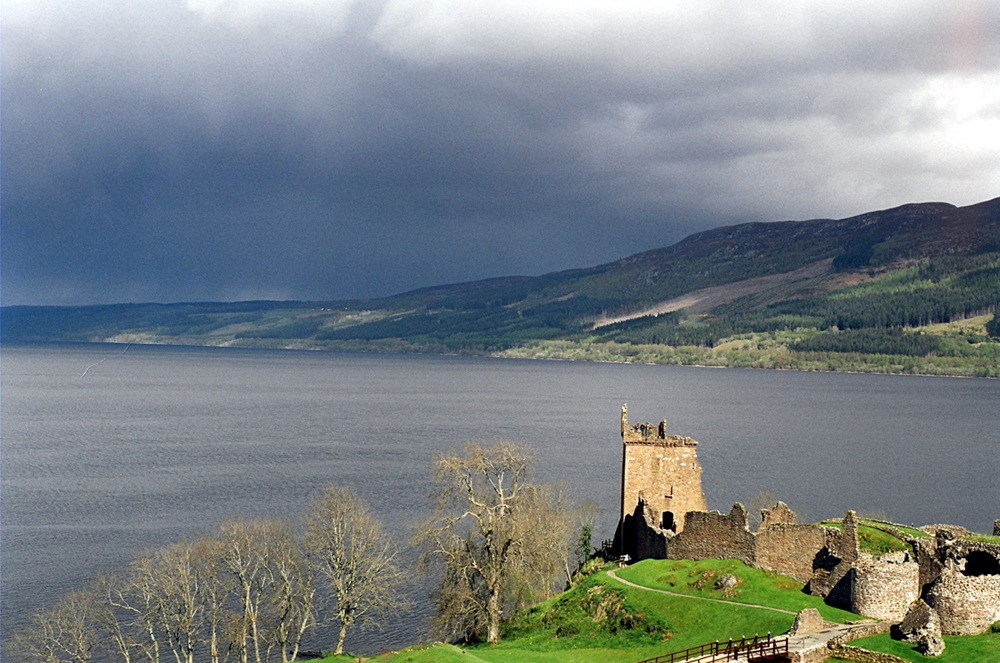
For most people around the world, the name “Loch Ness Monster” needs no elaborate introduction. Even mentioning the creature’s supposed home—a striking lake in the Scottish Highlands—immediately brings its mystery to mind.
Loch Ness is not the only lake associated with an unidentified aquatic creature. Across several of the world’s deepest lakes—Lake Champlain in New York, Lake Ikeda in Japan, Lake Storsjön in Sweden, and even Bear Lake in Montana—there have been reports and rumours of large, serpentine animals whose identities remain unexplained.
Yet it is the Loch Ness Monster that stands above all the others in fame. Accounts of a strange creature in the area date back to 565 AD, but it was not until 1933 that the mystery gained worldwide attention through photographs. Organized attempts to investigate the creature began in the early 1970s.
What, then, have people actually claimed to see? Because clear photographs are rare—and many are disputed or too poor in quality—scientists and researchers must rely on eyewitness descriptions. The most common one is of an animal with a long neck and small head, a bulky body, four flippers, and a long tail.
No living species matches this description, but one extinct group comes close. Plesiosaurs, prehistoric marine reptiles from the age of the dinosaurs, resemble what many witnesses describe. Although they are believed to have vanished 65 million years ago, there is no absolute proof that every species is gone.
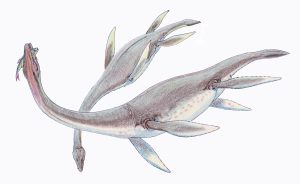
Artist’s impression of two plesiosaurs hunting fish
Supporters of this idea often point to the coelacanth—a fish from the dinosaur era once thought extinct until a living specimen was caught off southern Africa in the late 1930s. Crocodiles, also prehistoric, survive today. By coincidence plesiosaur fossils have been found near Loch Ness, showing that these animals once lived in the region.
However, there are problems with the plesiosaur theory. Plesiosaurs lived in saltwater, not freshwater like Loch Ness. Moreover, raising their heads above the surface in a swan-like pose would likely have broken their necks, as their skeletal structure did not support such movement.
Some scientists suggest that if plesiosaurs survived, they may have evolved stronger necks and the ability to hold their breath for long periods, which could explain the rarity of sightings. They could also have adapted to the freshwater environment of Loch Ness over time.
Because of these ideas, many people imagine the Loch Ness Monster as a surviving plesiosaur. Yet one sighting from the late 1880s or early 1890s hints at something that does not (seem) fit the plesiosaur explanation at all.
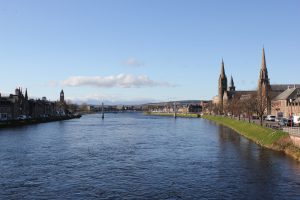
The River Ness from where Loch Ness gets its name in the town of Inverness
The River Ness, into which Loch Ness empties, forms the northern gateway to the Caledonian Canal, the great waterway that links Scotland’s east and west coasts. This river–canal junction is steeped in legend, for it was here that the earliest recorded encounter with the creature later known as “Nessie” was said to have taken place. In the sixth century, the Irish monk Columba reportedly invoked the name of God to save one of his followers from a fearsome aquatic beast in the River Ness—an episode long credited with helping Christianity take root in Scotland.
More than a thousand years later, another story from this same stretch of water would enter local lore but this time both below and above the surface of the water. According to accounts rediscovered in the early to mid‑1930s, a small ferry carrying a cargo of guano in either the late 1880s or early 1890s was travelling along the River Ness one night, just before entering Loch Ness, when it struck a submerged reef known locally as “Johnnie’s Point.” The crash sent the vessel to the bottom, though the captain and crew escaped unharmed. By dawn, the tops of the sails still protruded above the surface, raising hopes that the wreck may be salvageable.
A group of men quickly assembled and hired the services of a professional diver, Duncan MacDonald, who at the time was employed at the Crinan Canal. He arrived to inspect the wreck and descended into the water from the Caledonian Canal Company’s diving barge, positioned near the river mouth.
MacDonald was lowered roughly thirty feet into the dark, peat‑stained water where the ferry had come to rest against a rock ledge. Like Loch Ness itself, the River is filled with peat, particles of dead plant material which reduces visibility underwater and making it nearly eerie in darkness although the River has less peat in it than the Loch and thus it makes it easier for divers to be underwater unlike Loch Ness where sending divers down is a risky business . However, within minutes, he signalled urgently to be brought back up. When he reached the surface, he was visibly shaken—pale, trembling, and unable to speak about what had terrified him.
For several days he refused to say anything at all. Most of the men assumed he had simply been unnerved by the conditions below. But one man present—a local who already believed stories of a strange animal in Loch Ness—suspected otherwise. Unlike (the) others, he did not mock or dismiss the idea of something unknown living in the depths. Quietly and patiently, he encouraged MacDonald to speak, assuring him that whatever he had seen, he would be believed (at least by him). It was this man’s steady reassurance that finally persuaded MacDonald to reveal the truth to the others.
He explained that as he examined the hull of the sunken ferry, he became aware of a large creature resting on the rock shelf beside it. Later retellings describe it as an enormous, frog‑like animal—so large that some versions compare it to the size of a goat. What unsettled MacDonald most was not aggression despite its expression but indifference. The creature barely acknowledged him. It did not lunge, threaten, or even shift its position. It simply lay there, as though his presence meant nothing at all. Realizing that the animal had no intention of interfering with him, MacDonald made sure not to disturb it any more than it disturbed him.
His only instinct was to retreat calmly and signal to be brought back to the surface. The encounter left such an impression that he refused ever again to dive in Loch Ness or the River itself. As for the wreck itself, no further salvage attempts were made, and it was never recovered. The vessel slowly deteriorated where it lay, its timbers weakening and breaking apart over the years until it eventually decayed entirely. Nothing remained except the memory of the diver who had seen something lying beside it—something he would never forget, and something he would never have spoken of at all if not for the one man who believed him.
MacDonald’s account has long puzzled researchers because the creature he described looked nothing like the classic plesiosaur image associated with Nessie, yet the story does not entirely rule the plesiosaur theory out. His description of a huge, frog‑like animal resting on a rock shelf seems at first to contradict the long‑necked, flippered silhouette people expect, but the article suggests that if the creature is actually swan‑like in appearance regarding the head and neck, then MacDonald may simply have seen the head alone as it moved, with the neck and body hidden in the darkness, creating the impression of a compact, amphibian‑shaped form. In that interpretation, the moment when the creature “swam past him” could have been nothing more than the movement of a long neck sweeping through the water, which he could not distinguish from the rest of the body in the murky conditions. This possibility allows the plesiosaur theory to survive, because a plesiosaur viewed at close range, in poor visibility, and from an awkward angle may appear nothing like the elegant profile seen in illustrations.
At the same time, the story opens the door to alternative explanations that challenge the plesiosaur idea entirely. Some researchers have suggested that MacDonald may have encountered a giant catfish, an animal capable of reaching impressive sizes and known for resting motionless on riverbeds, though its overall shape still does not fully match his description. Others have proposed that Nessie could be an amphibian instead than a reptile, which aligns more closely with MacDonald’s frog‑like impression. Ordinary salamanders, however, cannot account for the size described, which is why some experts and enthusiasts as well as few scientists point to prehistoric species such as Hynerpeton, a large, robust Devonian amphibian whose body plan resembles an oversized salamander and could theoretically fit the diver’s account far better than any modern species. If Nessie were a relic amphibian of this kind, it would explain the creature’s squat posture, its apparent indifference to MacDonald, and its ability to rest on a submerged ledge without displaying the long neck associated with plesiosaurs.
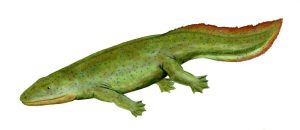
Hynerpeton life restoration
Thus the MacDonald incident stands at a strange crossroads in Loch Ness lore: it contradicts the plesiosaur theory by presenting a creature that looks nothing like one, yet it can also be interpreted in a way that preserves the theory if the diver simply misperceived a long‑necked animal in poor visibility. At the same time, it provides rare support for alternative candidates—giant fish, prehistoric amphibians, or unknown species—each of which fits certain aspects of the story while failing to explain others. In this way, the incident remains one of the most intriguing and ambiguous pieces of evidence in the entire Nessie tradition, capable of both undermining and reinforcing the theories that surround the creature’s identity.
The End