
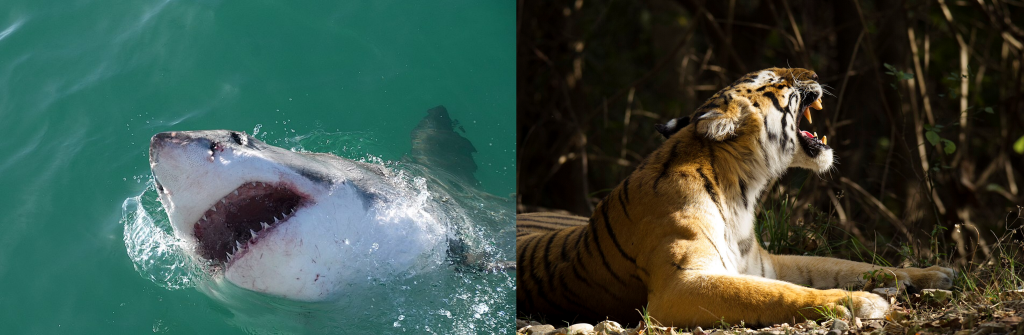
Attacks by wild animals on humans are statistically rare, yet they occur often enough to leave a deep impression on our collective imagination. Even large herbivores can be dangerous when threatened or startled—sometimes more immediately so than predators. Nevertheless, when people think of fatal wildlife encounters, the mind usually turns to carnivores and large omnivores. In such cases, there is often an assumption that the animal has developed a taste for human flesh and has become what is popularly termed a “man-eater.”
On land, large predators such as lions, tigers, leopards bears, and wolves have all been responsible for attacks on humans. In aquatic environments, crocodiles in rivers and estuaries and sharks at sea account for most fatal incidents. Before concluding that these animals deliberately hunt humans as preferred prey, it is important to consider the ecological and behavioural contexts behind such attacks. In the case of big cats, it has long been observed that predators who are elderly, injured, or unable to pursue their natural prey—such as deer or antelope—may turn to humans, who are comparatively slow and often unarmed. In other instances, attacks may follow provocation, habitat encroachment, or accidental encounters. While repeated attacks by the same predator have occurred, the idea that a “taste for human flesh” is consciously cultivated or passed on to offspring remains more folklore than established science.
History nevertheless remembers certain notorious cases. The Tsavo man-eaters were two male lions that terrorised workers constructing the Uganda Railway in 1898 in what is now Kenya. Modern research and historical reassessment suggest they killed at least 28 or 35 railway workers, though earlier claims placed the number as high as 135. The railway’s chief engineer, John Henry Patterson, undertook the prolonged effort to hunt them down. After months of failed attempts and mounting tension among the workforce, he eventually shot both lions, allowing construction to resume.
In British India, another name became synonymous with the pursuit of man-eaters: Jim Corbett. Over the course of his career, Corbett is credited with killing 19 man-eating tigers and 14 man-eating leopards between 1907 and 1938. Many of the tigers he tracked were found to be injured—often by gunshot wounds inflicted by others—or incapacitated in ways that prevented them from hunting their usual prey. Corbett later became an advocate for wildlife conservation, and Jim Corbett National Park was named in his honour.
In the marine realm, popular culture has also drawn upon real events. The novel Jaws and its 1975 film adaptation were partly inspired by the Jersey Shore shark attacks, a series of attacks along the coast of New Jersey in July 1916. Over twelve days, five people were attacked and four were killed, including victims in both coastal waters and a tidal creek. Although the exact species involved has been debated, the incident intensified public fear of sharks and helped shape their portrayal as deliberate predators of humans. In reality, most shark attacks are believed to result from mistaken identity—particularly in conditions of poor visibility, where a swimmer or surfer may resemble a seal from below. Crocodiles, by contrast, are opportunistic ambush predators and are known to include humans within their potential prey range in certain regions.
While the Tsavo lions, the tigers shot by Corbett, and the Jersey Shore attacks have become embedded in popular history and literature, other encounters between humans and large predators have received far less attention. The two events explored here—one involving tigers in India and the other sharks in Australia—share striking parallels. In both cases, people survived life-threatening attacks and later reflected on the animals not solely as villains, but as powerful forces of nature. Their experiences reshaped their understanding of these predators and, ultimately, changed the course of their lives.
Rodney Fox
Rodney Fox entered the annual spearfishing championship in 1963 determined to win again, racing against time to find the one big fish that would secure his title. The water around the competitors had grown thick with the scent of blood from their catches, and as Rodney finally spotted the prize he needed, something slammed into him with the force of a speeding train. In an instant he was torn from the world of competition and hurled into a nightmare. A great white shark had caught him so hard that his mask flew off and his spear gun vanished from his hand, Before he could react its jaws closed around his chest and back, dragging him into the deep.
He fought blindly, striking the shark with his fists as it shook him like prey, until he remembered the one vulnerable place on its body. Summoning the last of his strength, he drove his hand into the shark’s eye, and miraculously it released him. Bleeding heavily and nearly out of air, he kicked toward the surface, only to see the shark racing after him again. Its jaws snapped shut—not on him this time, but on the float line attached to his belt. The shark swallowed the float and dived, pulling Rodney down with it. He tried desperately to undo the belt, but the buckle had twisted behind him and his arms were too weak to reach. After surviving the bite, he now faced the certainty of drowning.
Then, by sheer luck, the line snapped. The shark’s teeth had partially severed it earlier, and the strain of dragging him through the water finished the job. Rodney thrust his way upward, barely conscious, and surfaced beside a boat of horrified friends who hauled him aboard. His injuries were catastrophic—his ribs crushed, a lung punctured, and deep gashes exposing bone. Four hours of surgery and 462 stitches saved his life, leaving a scar that would mark him forever.
News of the attack spread quickly, stirring fear and calls for vengeance through shark hunting, but Rodney’s own response moved in the opposite direction. Once he recovered, he returned to the sea within months, determined not to let terror define him. Instead of hunting sharks, he set out to understand them. He studied their behaviour, listened to other survivors, and eventually designed the first shark cage so he could observe great whites safely and up close. His expertise grew so deep that he later advised the makers of Jaws (although he is not credited presumably because of asking not to be credited), lectured around the world, and became a leading voice for shark conservation. He argued that great whites were essential to the balance of the ocean, that their numbers were dwindling, and that anyone who entered their realm had to accept the risks (in this case the smell of blood from the fish he had caught was probably what caused the shark to approach him).
Rodney Fox survived one of the most brutal shark attacks ever recorded, but what defined him was not the violence of the encounter—it was the courage to return, to learn, and to transform fear into knowledge that would change how the world understood sharks.
Subedar Ali
Corbett National Park, named after Jim Corbett—the hunter‑turned‑conservationist who once tracked man‑eaters but later taught India to value the tiger—has long been a landscape where beauty and danger coexist. By the early 1980s, the park had already seen tragedy: in 1982 a fodder collector was killed by a tiger, and two years later his friend narrowly survived a similar attack. From that point on, no mahout or fodder cutter entered the forest alone.
Twenty‑six‑year‑old Subedar Ali, a mahout based in Corbett, rode into the jungle with his friend Qutub to collect fodder for their elephants. The morning felt calm as they reached the Chooha Sot area, though it was the very place where their colleague had died. The two men separated, and Subedar chained his elephant before climbing a banyan tree—chosen at Qutub’s suggestion even though it stood farther away. He was about twelve feet above the ground when his elephant began hissing. Assuming she was hungry, he climbed down to feed her, only to be distracted by the branches he had cut earlier. As he bent toward them, a tremendous blow struck his back, hurling him to the ground. He landed on top of a tiger.
The tiger immediately attacked his head and began dragging him away. Subedar rolled onto his back to shield his abdomen and throat, but the tiger’s jaws clamped onto his shoulder, tearing away part of it. In the chaos he saw his own scalp hanging from the tiger’s mouth. The animal flipped him over and straddled him like a rag doll. Desperate, he thrust his hand into the tiger’s mouth, hoping to force a release, but two fingers were nearly severed. The tiger slashed his face, cutting his eyelids, and ripped away most of his clothing, as often happens in tiger attacks.
His screams carried through the forest. Qutub arrived on his elephant, whose presence forced the tiger to back off. Subedar staggered toward his own elephant, who lifted him onto her back. The two elephants, each carrying their wounded or shaken mahout, moved steadily toward the park offices while the tiger followed for much of the way before finally giving up the pursuit.
Subedar was rushed first to a small hospital, where a doctor sutured the claw and bite wounds, and then to a larger facility where surgeons grafted skin from his legs to rebuild his scalp and repaired his fingers and eyelids. He regained consciousness at the All‑India Institute of Medical Sciences and asked that his family not be told immediately. Over the following months he endured multiple operations, slowly recovering from injuries that would have killed almost anyone else.
Two weeks after the attack, forest staff identified the tiger by its pugmarks, tracked it down, and captured it alive. It was sent to Kanpur Zoo, where it lived out the rest of its life. When Subedar later visited the tiger, he was struck by its sheer size—2.7 metres long and weighing 304 kilograms. He bore no hatred toward the species and believed that even a man‑eater should be captured rather than killed, though he felt a quiet sadness for this particular tiger, which had doomed itself by attacking a human.
Despite his mother’s pleas to leave the profession, Subedar refused. Being a mahout was his calling, and he returned to his duties once he had healed. His survival story became the subject of a wildlife documentary, and he received several bravery awards. Visitors often asked to ride his elephant, and in time he became involved in tiger conservation, leading patrols across Corbett to help protect the very species that had nearly taken his life.
What endured was not only the ferocity of the attack but the extraordinary resilience of a man who faced a tiger with nothing but his bare hands, survived, and chose to return to the forest with a deeper commitment to the animals that share it.
Similarities
While both these attacks are different because they occurred at land and at sea respectively though the latter is older than the former, they are seeming mirror images because of the following.
Earlier attacks and in the same place
another tragedy unfolded off Aldinga Beach—the very same stretch of coastline where he had once been mauled. A group of university divers had been exploring the Drop Off, a reef ledge where fish gathered in dense, glittering shoals. The sea was calm. The visibility was excellent. Nothing hinted at danger.
Then a four‑metre shark erupted out of the blue. A thunderous roar filled the water, a vibration so powerful that off‑duty police officer Dave Roberts felt it before he understood it. The shark tore past him, thrashing its head violently. He could not see his friend. He did not need to. The sound alone told him the shark had taken him. The attack was over in seconds—one massive grab, no warning, no struggle. When the water settled, only the victim’s air tank and hose remained.
The coincidence was chilling: the same place, the same species, the same suddenness—nearly three decades after Fox had fought for his life in those waters.
A similar pattern emerged in Corbett Park, though the timing was reversed. Two years before Subedar Ali survived his tiger attack, a friend and colleague had been taken in the very same spot while working alone. No one ever learned what became of the man’s elephant. The park authorities responded by ensuring no mahout or fodder cutter entered the jungle unaccompanied, yet—ironically—this precaution made little difference when Ali’s turn came.
And the pattern did not end there. A year after Subedar was attacked, in 1985, a British ornithologist named David Hunt was killed in Corbett after straying from his group to photograph a bird. He was mauled and partly eaten before help could reach him. The park had once again shown how swiftly danger could surface, even in the presence of others.
The contrast between the two sets of coincidences is striking. At Aldinga, the second attack came long after Fox’s ordeal, separated by nearly thirty years. In Corbett, the earlier death preceded Subedar’s attack by only a short span, a sinister foreshadowing instead of a distant echo which would even come a year later. And in both places, the presence of others offered no protection. Fox had been diving with friends when he was struck. The university divers were in a group when the shark returned to the same reef. In Corbett, even though no mahout travelled alone after the earlier killing, the tiger still found its moment. Even tourists moving in a group
Fighting back and the experiences of it
In both cases, the victims did fight back. Rodney Fox struck the shark in the eye and snout while being shaken and dragged underwater, and Subedar Ali struck the tiger on the nose and forced his hand into its mouth while being mauled on the ground. Both attacks happened suddenly and without warning: Fox was hit from behind during a spearfishing competition, and Subedar was pulled from a tree by a tiger that appeared without any sign of approach. Each predator used overwhelming force, leaving the victims with severe injuries—Fox’s chest and back were torn open, and Subedar was bitten repeatedly, scalped, and dragged across the forest floor.
Both men remained conscious despite the extent of their wounds. Fox surfaced able to call for help even with massive trauma, and Subedar stayed awake long enough to shout for assistance even after seeing his own scalp in the tiger’s mouth. During the struggle, both men thought of their families. Fox later said that the thought of his wife and the child she was expecting pushed him to keep fighting, and Subedar said that as he prayed, he called on both the Hindu gods he had grown up hearing about and, as a Muslim, on Allah, which he believed helped him stay conscious long enough to survive.
In both incidents, survival as always depended on immediate help from others. Fox’s friends pulled him into a boat, and Subedar’s colleague Qutub arrived on an elephant and forced the tiger to retreat. Both required extensive medical treatment afterward, with Fox receiving 462 stitches and major surgery, and Subedar receiving 170 stitches, multiple operations, and reconstructive procedures.
Both men survived extreme injuries, and their families were deeply concerned by what had happened to them. Fox’s family saw how close he had come to dying and the extent of the damage to his chest and back, and Subedar’s mother urged him to leave his work after learning the details of the tiger attack. Despite this, neither man treated the animal that attacked him as something to hate or retaliate against. Fox returned to the sea, studied great white sharks, and eventually became an expert on them, emphasising their importance rather than seeking revenge. Subedar resumed his duties as a mahout in Corbett Park and continued working around wildlife, stating that he did not hold anger toward the tiger and that he believed it should be captured rather than killed.
The difference is that the tiger which attacked Subedar was later identified, captured, and sent to a zoo because it had already been recognised as a danger to people, whereas the shark that attacked Fox was never caught and its identity remained unknown.
Pingback: hello world
What can I do for you?